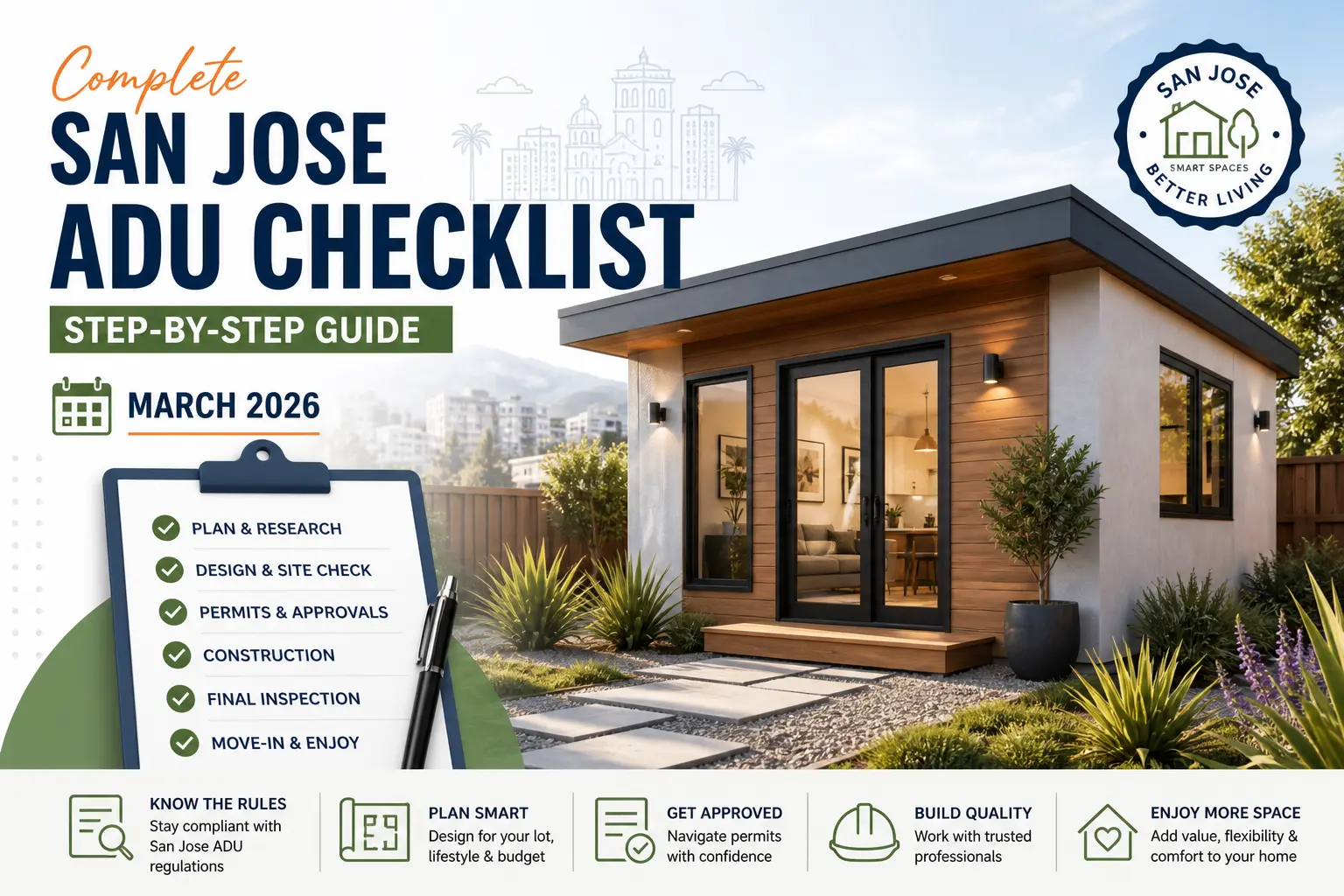
This checklist is intended to help property owners and developers evaluate project feasibility before investing in design, engineering, and permit applications. It focuses on site conditions, property constraints, and project planning considerations.
For a broader understanding of ADU and JADU regulations, review our Comprehensive California ADU Requirements. To understand local setbacks, height limits, and zoning standards, see our San Jose ADU Rules 2026. For permit procedures, corrections, and common project questions, refer to our San Jose ADU Permits Process FAQs article.
San Jose ADU and JADU Technical Feasibility Study Explained
The City of San Jose’s ADU and JADU program is covered in two articles. The first article focuses on the ADU technical feasibility study. The second article will present the city’s ADU zoning and regulations, based on the ADU Universal Checklist and related City documents.
San Jose ADU and JADU Program and Development Overview
The City maintains a comprehensive program for Accessory Dwelling Units (ADUs) and Junior Accessory Dwelling Units (JADUs), covering planning, zoning, permitting, and construction requirements, including the current San Jose ADU requirements (2026 update) and updates to San Jose JADU rules.
What is an ADU and a JADU?
The city of San Jose PBCE Housing Production Dashboard Glossary defines an ADU as follows: “Accessory Dwelling Units (ADUs) are secondary housing units that can be attached or detached and provide complete, independent living facilities for one or more persons, and are located on a lot with a primary residence. ADUs may also be within the living area of an existing dwelling (known as Junior ADUs or JADUs).”
Housing Targets and ADU Contribution in San Jose
San Jose is the largest city in Northern California and a major economic center of Silicon Valley. The City aims to create 62,200 units by 2031 to meet its Regional Housing Needs Allocation (RHNA) requirements. Based on data from Jan. 1st, 2023, to Dec. 19th, 2025, ADUs account for almost 23% of completed residential building units (1,085 of 4,802), representing a meaningful share of housing production and contributing to the City’s progress toward its 2031 housing goals. As a result, ADU design services in San Jose are rising, which in turn increases demand for ADU construction services.
ADU Permit Growth and Size Trends
The City of San Jose Blog reports that building permits for Accessory Dwelling Units (ADUs) have skyrocketed in recent years. Back in 2015, the City of San José issued just 10 ADU building permits. Fast-forward to 2024, and that number increased to 488 permits. The report shows that in 2015, only 6% of permitted ADUs were over 700 square feet. Today, more than one-third are considered large ADUs. Homeowners clearly see the value in maximizing their space.
San Jose ADU Feasibility Study
Legal considerations for ADUs in San Jose center on a technical feasibility checklist. The first step in the San Jose ADU permit process is completing a feasibility review using the City’s Bulletin #210, which helps applicants determine whether an ADU or JADU project is viable before investing time and money. The City provides guidance through Bulletin #210 (updated March 5, 2026, subject to change) and related materials available on the City’s ADU webpage. This checklist supports compliance with San Jose ADU requirements by addressing key feasibility and compliance questions. Final compliance is subject to City plan check review.
San Jose ADU Universal Checklist Questions
The checklist comprises five key questions that guide homeowners, architects, and designers through the San Jose ADU and JADU feasibility study process. It also outlines key differences between San Jose JADU vs. ADU regulations.
The five checklist questions:
- Property Eligibility,
- Property Designations,
- Selecting ADU Ordinances,
- Fire Protection,
- Miscellaneous Requirements
Property Eligibility for ADU or JADU
There are three primary eligibility criteria. Applicants can access the required information at www.sjpermits.org by clicking the Search Permits, Property & Zoning button. Applicants can use “Search in Map,” “Search by Address,” or “Search by APN” to reach the Property Search Results page. The required information for the property’s eligibility for an ADU or JADU is available on that page.
Jurisdiction
The applicant must verify that the property is within the City of San Jose’s jurisdiction (not unincorporated Santa Clara County) using sjpermits.org.
Zoning
The property must be zoned to allow ADU development.
Violations
The property must not have active code enforcement violations that would prevent permit issuance.
Property Designations and Site Constraints
Six designations affect architectural and structural design requirements and define submittal plans and requirements, which may vary by project. The applicant can refer to www.sjpermits.org to access the property’s public information, identify the property’s characteristics, and determine whether additional plans beyond the basic submittal are required.
Flood Zone
If the property is in flood zones A, AE, AH, or AO, plans must comply with the flood zone design requirements in Bulletin #211-ADU Plan Requirements; these requirements do not apply to flood zones D and X.
Geohazard, Seismic, Liquefaction Zone
If the Geohazard Zone and Seismic Hazards in the property’s public information on the sjpermits.org portal are positive or indicate a landslide, a “Geologic Hazard Clearance” is required. If “liquefaction” is indicated and two or more units are proposed, a “Geologic Clearance” is required.
Historic
If the property is listed as HISTORIC on the City’s Historic Resources Inventory map or the California Historical Resources list for Santa Clara County, and the applicant selects the City Development Standards (see Part 3) for the ADU design, the applicant must apply the simplified design standards in Municipal Code Section 20.80.175 (E) to the project. If the applicant selects the State Development Standards, local zoning design standards are limited under State ADU Law; however, building, fire, and objective requirements still apply.
WUI Zone
If the property is in a Wildland-Urban Interface Zone (WUI) as defined on page 3 of the WUI Fire Conformance, the construction must comply with all requirements set forth in the WUI policy.
Easements
If the property has a dedicated easement shown in the title report or in the tract and parcel maps available through the County Surveyor Record Index tool (which is less accurate than a title report), the applicant must comply with the easement requirements; construction may be restricted depending on the easement type.
Non-buildable Area
If the property is in a non-buildable area at the proposed ADU location, such as a demolished swimming pool, or if you’re uncertain about a former pool on your property and find it listed as a swimming pool demolition on sjpermits.org, your submittal package must include pool demolition documents, either a plot plan showing the requirements per Bulletin #289-Swimming Pool Demolition Requirements or a geotechnical report and foundation design, which may require an engineer’s services.
Selection of Development Standards (City vs State)
The applicant must select one of the following ADU design ordinances for the ADU or JADU, based on their needs and project goals. The architect, designer, or any provider of ADU design services in San Jose must comply with the selected ordinance and applicable development standards in the design. This selection determines compliance with San Jose ADU requirements (2026 update) and the San Jose JADU rules. It compares the San Jose attached ADU requirements with those for a San Jose detached ADU.
- The City ADU & JADU Standards (Municipal Code 20.80.175).
- The State ADU & JADU Standards (Municipal Code 20.80.176).
Standards cannot be mixed; the applicant must choose either all City Standards or all State Standards. The selected legal considerations for ADUs in San Jose define:
- Allowed number of ADUs and JADUs in a property
- Minimum and maximum Size for ADUs and JADUs
- Minimum Front, Rear, and Side Setback
- Maximum ADU height limits for one and two-story ADUs.
- Maximum number of stories
- Number of Bedrooms / Bathrooms
- Siting; Location of the ADU
- Other Standards, Rear yard coverage, Building Separation Distance, Front Door Side
- Historic Property Regulations
- Parking Requirements
The additional JADU ordinances address Section 20.80.178 of Ord. 30984 – Junior accessory dwelling units – Single-family dwelling lot, which can help the homeowners and architects who look to obtain a permit and build a JADU in San Jose.
- Entrance and interior entry doors
- Efficiency kitchen
- Parking
- Owner occupancy
- Deed restriction
- Garage conversion
- JADU & ADU
- Bathroom
Fire Safety and Emergency Access Requirements
The City’s Fire Bureau will review your plans for compliance with the California Fire Code (CFC).
Addresses
On the Site Plan for submittal, show the address locations (“premises identification”) for the main dwelling unit and the ADU. If both addresses are legible and visible from the front street, the ADU project complies. If not, the plans must be revised accordingly.
Fire Crew Access
If the distance from the lot’s street curb to the farthest side of the proposed ADU is no more than 150 feet, the ADU may comply with fire access requirements, subject to Fire Department review. Otherwise, the applicant may need a fire variance, which requires additional safety measures. (The distance is measured along a minimum 4-foot clear path to all sides of the ADU, from the front property line to the ADU’s farthest exterior point, which may include eaves.)
Fire Hydrant Distance
If the farthest exterior wall of the ADU is within 600 feet of a fire hydrant, measured along a minimum 4-foot clear path of travel, no additional requirements apply to the property. Otherwise, the applicant may need to request additional safety measures or submit a fire variance application.
Fire Hydrant Flow
If a minimum flow of 1,000 gpm at 20 psi is available at the closest hydrant, as reported by the Water Company, no additional fire safety measures are required. Otherwise, the fire staff will evaluate whether additional measures are required.
Fire Sprinkler
● If a fire sprinkler system protects the primary residence, the ADU must also be protected by one.
● If the project is an attached ADU greater than 500 sf and the combined gross floor area of the main unit and the ADU exceeds 3,600 sf, the entire house and ADU must be equipped with a fire sprinkler system.
Miscellaneous Requirements
Heritage Tree – Will building an ADU require removing a City of San José-listed heritage tree? If so, the applicant shall visit www.sanjoseca.gov TreePermit and follow the instructions for heritage trees.
Impact Fees – Is the ADU 750 sf or larger? If so, the applicant must pay school and parkland impact fees. Certain impact fees may not apply to ADUs smaller than 750 sf. At the time of your project submittal, staff will provide a school fee referral form.
The City of San Jose also provides additional ADU documents and checklists, along with design ordinances and development information. One important document for the construction phase is the Inspection Checklist for ADUs, BULLETIN #213, which helps homeowners who want to build an ADU or JADU, as well as contractors who provide ADU construction services in San Jose, avoid costly mistakes and plan for a successful inspection. This article will be covered after the design and permit process section.
ADU rules in San Jose have been getting easier year by year, so it’s a good time to move forward if you’re thinking about building one. Still, having an experienced ADU designer helps you avoid delays and get through the permitting process without unnecessary back-and-forth. You can visit our ADU design services page to get started. If you’re planning a single-family home with an ADU, take a look at our residential design services as well.
H2: References
- ADU Universal Checklist (Bulletin #210), City of San José PBCE, updated March 5, 2026 (subject to change).
- ADU & SB 9 Trends: What San José Homeowners Need to Know, City of San José, Blog Post, May 30, 2025.
- B-007 – ADU Fire Separation Distance Requirements, City of San José PBCE, March 23, 2022.
- BDN 34 – Junior Accessory Dwelling Unit (JADU), City of San José PBCE, June 9, 2021.
- Housing Production Dashboard – Completed Residential Building Units & ADU Data, City of San José PBCE.
- Inspection Checklist for ADUs (Bulletin #213), City of San José PBCE, November 14, 2019 (Subject to Change)
Disclaimer: This content is for general informational purposes related to ADU design and planning and does not constitute legal, zoning, or permitting advice. Regulations may vary by jurisdiction and may change over time. For project-specific guidance, consult your local planning department or a qualified professional. Requirements are subject to verification with the City of San Jose and may change over time.