
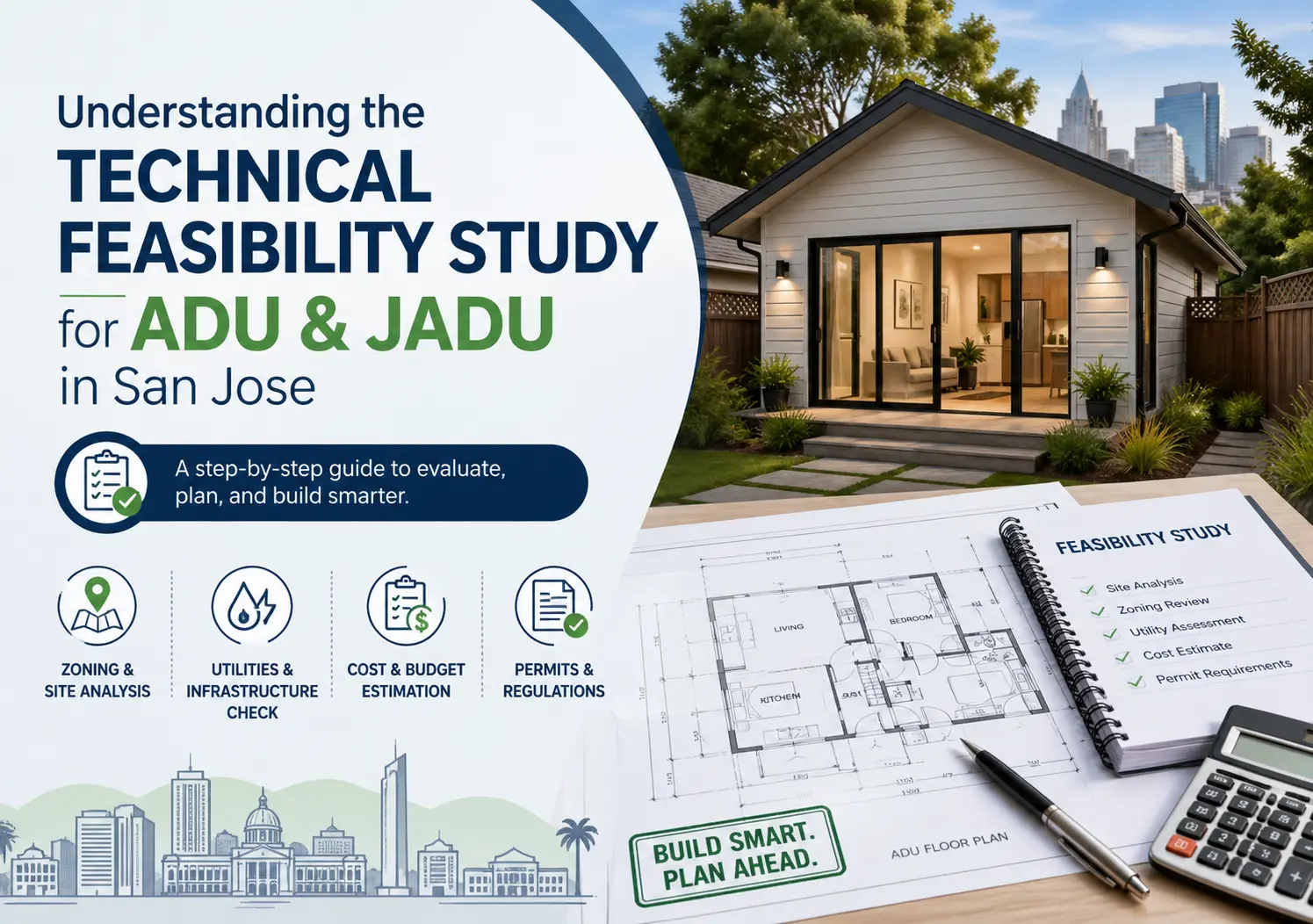
This guide explains the fundamentals of ADUs and JADUs in California, including unit types, eligibility requirements, and California regulations affecting residential properties.
Once you understand the ADU and JADU regulations, you may want to review our Complete San Jose ADU Checklist to evaluate project feasibility, our San Jose ADU Rules 2026 for local development standards, and our San Jose ADU Permit Process FAQs article for permit-related questions and practical project considerations.
Accessory Dwelling Units (ADUs) are established by California State ADU law, codified in California Government Code Section 65852.2, and by JADU law under Section 65852.22 and related provisions. These regulations allow homeowners in California to design and construct ADUs on residential properties, subject to streamlined local approval standards and limited local restrictions.
This article summarizes selected provisions of California ADU regulations, based on the ADU Handbook (March 2026) published by the California Department of Housing and Community Development (HCD). It includes additional information as well.
In upcoming articles, we will publish the ADU ordinances for the City of San Jose, the City of Fremont, and additional jurisdictions.
Why ADUs Are Booming in California: Trends, Benefits & Legal Insights
An ADU (Accessory Dwelling Unit), sometimes historically referred to as a “granny flat,” is a separate dwelling on the same lot as a single-family or multi-family home. It serves as an independent housing unit that helps meet housing demand affordably and encourages homeownership by simplifying ordinances and administrative procedures. The modern ADU framework was significantly expanded through California state legislation beginning in 2016 and is implemented and administered by the California Department of Housing and Community Development, resulting in high demand for ADU construction services and design services statewide.
ADU Development Trends
California has made significant progress in ADU development, with a strong impact. Between 2016 and 2024, the number of ADUs approved annually in the state rose from 1,336 to 30,354. In 2024, ADUs accounted for more than 26.6 percent of all permitted dwelling units statewide.
A review of the San Jose PBCE Housing Production Dashboard shows that, in San Jose, the largest city in Northern California, 1,085 of 4,802 completed buildings from the beginning of 2023 through late 2025 were ADUs, representing about 23% of the total. This trend has increased demand for ADU design services and ADU designers in San Jose.
What is an ADU and JADU?
California law defines the ADUs and JADUs as follows. “Accessory Dwelling Unit (ADU) An attached or a detached residential dwelling unit that provides complete, independent living facilities for one or more persons, and is located on a lot with a proposed or existing primary residence. It shall include permanent provisions for living, sleeping, eating, cooking, and sanitation on the same parcel as the single-family or multifamily dwelling is, or will be, situated.
An ADU also includes the following: (A) An efficiency unit. (B) A manufactured home, as defined in Section 18007 of the Health and Safety Code. Source: Government Code section 66313, subdivision (a).”
Benefits of building an ADU to Homeowners
ADUs provide several benefits to homeowners, including:
- ADUs are an affordable housing option in California because the owner does not pay for the land, new infrastructure, or parking spaces.
- Homeowners can benefit from rental income.
- ADUs allow extended families to live on the same property while maintaining privacy and independence.
- Supportive policies, such as streamlined permitting, help homeowners build ADUs and maximize their utility.
- The benefits have led to substantial demand for ADU architects and designers, and ADU construction services statewide.
Local government adoption
Local governments may adopt or amend ADU ordinances to comply with state regulations. They must submit the ADU ordinance to the California Department of Housing and Community Development for review. The department will review the ordinance and issue written findings to determine whether the adoption complies with California law.
The ADU designers must comply with applicable state ADU regulations and, where applicable, ADU ordinances adopted or amended by local agencies.
Types of ADUs explained
There are five main types of ADUs. Each might be regulated differently by zoning laws, though some may share common rules.
- Detached ADU
- Attached ADU
- Converting the interior of the main residence into an ADU
- Converting the garage into an ADU
- Converting an accessory structure into an ADU
(The attached ADUs may be located above garages, basements, or additions)
ADU building regulations
California rules limit the ability of local agencies to restrict the ADU architectural design ordinances and construction of an ADU under local zoning ordinances, including, but not limited to:
- Minimum lot size requirements for ADUs.
- Landscape and open space requirements.
- Lot coverage and floor area ratio (FAR) requirements that would otherwise restrict or preclude the construction of an ADU of at least 800 square feet meeting state requirements.
- Certain zoning ordinance requirements, including height, size, setbacks, etc.
ADU setback rules explained
The attached or detached ADU must have side and rear setbacks of no more than 4 feet.
Front yard setbacks cannot preclude an ADU of at least 800 square feet from being built on the property, even if that ADU would exist partially or wholly within the front setback
ADU size
State law requires local agencies to permit an ADU of at least 850 square feet, or 1,000 square feet if it has more than one bedroom. A local government may set a maximum floor area for attached and detached ADUs that is not less than the amount approved by the California rules.
The maximum floor area for a new detached ADU allowed by California law is 1,200 square feet unless a local government has set a different limit. For an attached ADU, the maximum is up to 50 percent of the primary residence’s floor area, but not less than 800 square feet, as defined by state law.
The minimum efficient unit floor area, defined as 150 square feet by the Health and Safety Code, is set by California law; a local agency should not establish a lower minimum.
Converting an existing accessory or part of the primary residence into an ADU is not limited by size.
ADU height restrictions
The 16-foot height limit for a lot with an existing or proposed single-family residence is protected by state law, and local agencies cannot reduce it.
If a detached two-story ADU can be built within the height limits set by the state regulations and remains compliant with the building code, a local agency cannot deny an ADU application for a two-story ADU, regardless of the underlying zoning that might restrict a primary dwelling to one story.
The maximum height is 25 feet or the height limit for the primary dwelling under zoning ordinances, whichever is lower. There is no requirement for a local agency to permit an ADU to exceed two stories.
ADU parking exemption rules
The required parking spaces are limited to no more than one parking space per ADU or per bedroom, whichever is less, including tandem parking in the driveway. Guest parking is not required. State-mandated parking exemptions include:
- An ADU located within half a mile of public transit.
- An ADU situated in a district of architectural and historical significance.
- An ADU located within a proposed or existing primary residence or an accessory building.
- When an ADU permit application is submitted concurrently with the main residence permit application, provided that the ADU or the parcel meets any other criteria listed in Government Code section 66322, subdivision (a)(1)-(5).
- In an efficient unit that does not include bedrooms.
- When any covered parking structure is demolished to build or convert into an ADU.
Local agencies can remove additional barriers, simplify ADU construction, and encourage development by reducing or eliminating parking requirements for ADUs.
Fire sprinkler
Fire sprinklers for ADUs and JADUs are required when the primary residence must have them under the adopted building code thresholds (the California Building Code and the California Fire Code).
ADU permit approval process
Under state law, ADU permit applications are handled on a ministerial basis, meaning the review is based only on clear, objective standards. Local agencies cannot use discretionary review, public hearings, or subjective design opinions to approve or deny the application.
Under SB 543 (2026 framework), the permitting agency must determine within 15 business days whether the application is complete. Once the application is deemed complete, the local agency must approve or deny the ADU within 60 days, based only on objective standards.
2026 California ADU Law Updates (Key Bills Explained)
These updates are based on the California Department of Housing and Community Development ADU Handbook (March 2026) and related state legislation. They primarily refine how ADUs are processed, how limits are applied, and how cities must comply. The rules are not dramatically new — they are clearer and more strictly enforced.
Assembly Bills (AB)
AB 1154 — JADU rules clarified
This law clarifies confusion around Junior ADUs (JADUs). The size limit remains at 500 sq ft of interior livable space, and the definition is now consistent across cities.
- If the JADU has its own bathroom and kitchen, the owner does not need to live on the property
- If it shares facilities with the main house, owner occupancy is required
- JADUs must be rented for 30+ days; short-term rentals are not allowed
This primarily standardizes interpretation, not expanding what is allowed.
AB 818 — Emergency ADU permitting (limited use)
This applies only during declared emergencies or disasters.
- •ADUs (typically modular or prefabricated units) must be approved within 10 business days of a complete application.
- •Utility providers must issue a written response outlining the issues within 30 calendar days (not full connection approval).
This is a fast-track system for emergency housing, not normal permitting.
AB 2533 — Legalization of existing ADUs
This law focuses on ADUs built before January 1, 2020.
- •These units can be legalized without full compliance with current building standards.
- •Only basic health and safety upgrades may be required.
- •The goal is to bring existing housing into compliance rather than remove it.
AB 1308 — Final inspection timeline enforcement
This rule addresses delays at the end of construction.
- Final inspections must be completed within 10 business days of notification or request
This ensures projects do not get stuck after construction is finished.
Senate Bills (SB)
SB 543 — Core ADU enforcement law (the most important update)
This is the primary 2026 update governing how cities process ADU applications.
- Application completeness review within 15 days
- Approval or denial within 60 days (ministerial, no hearings)
- No impact fees for ADUs up to 750 sq ft
- JADUs up to 500 sq ft are also exempt from fees
- Larger ADUs must be charged only proportional impact fees
- All size limits are based on interior livable space, not gross square footage
Cities must also provide a written explanation for incomplete or denied applications.
SB 1211 — Multifamily ADU expansion (with cap rule)
This law allows ADUs on multifamily properties but includes limits.
- Detached ADUs may be added with a total of 8 units
- However, the number of new detached ADUs cannot exceed the number of existing residential units on the property
Example:
- A 4-unit building can add up to 4 ADUs, not 8
This keeps development proportional to the existing structure.
SB 9 (2025 enforcement update)
This version strengthens state oversight of local compliance.
- If a city fails to submit its ADU ordinance to the state within 60 days, the ordinance becomes invalid.
- If the state issues corrections, the city must address them within 30 days
- If the corrections are not addressed, the state can override local rules
This ensures that cities cannot delay or weaken state housing laws.
Arbel Design provides ADU design services in San Jose, the Bay Area, and Los Angeles for all types of ADUs and JADUs.
References & Disclaimer
- California Government Code § 65852.2 – ADUs
- California Government Code § 65852.22 – JADUs
- California Department of Housing and Community Development (HCD) – Accessory Dwelling Unit Handbook (March 2026 Edition).
- San José Planning, Building and Code Enforcement (PBCE) – Housing Production Dashboard
Disclaimer: This content is for general informational purposes related to ADU design and planning and does not constitute legal, zoning, or permitting advice. Regulations may vary by jurisdiction and may change over time. For project-specific guidance, consult your local planning department or a qualified professional.