
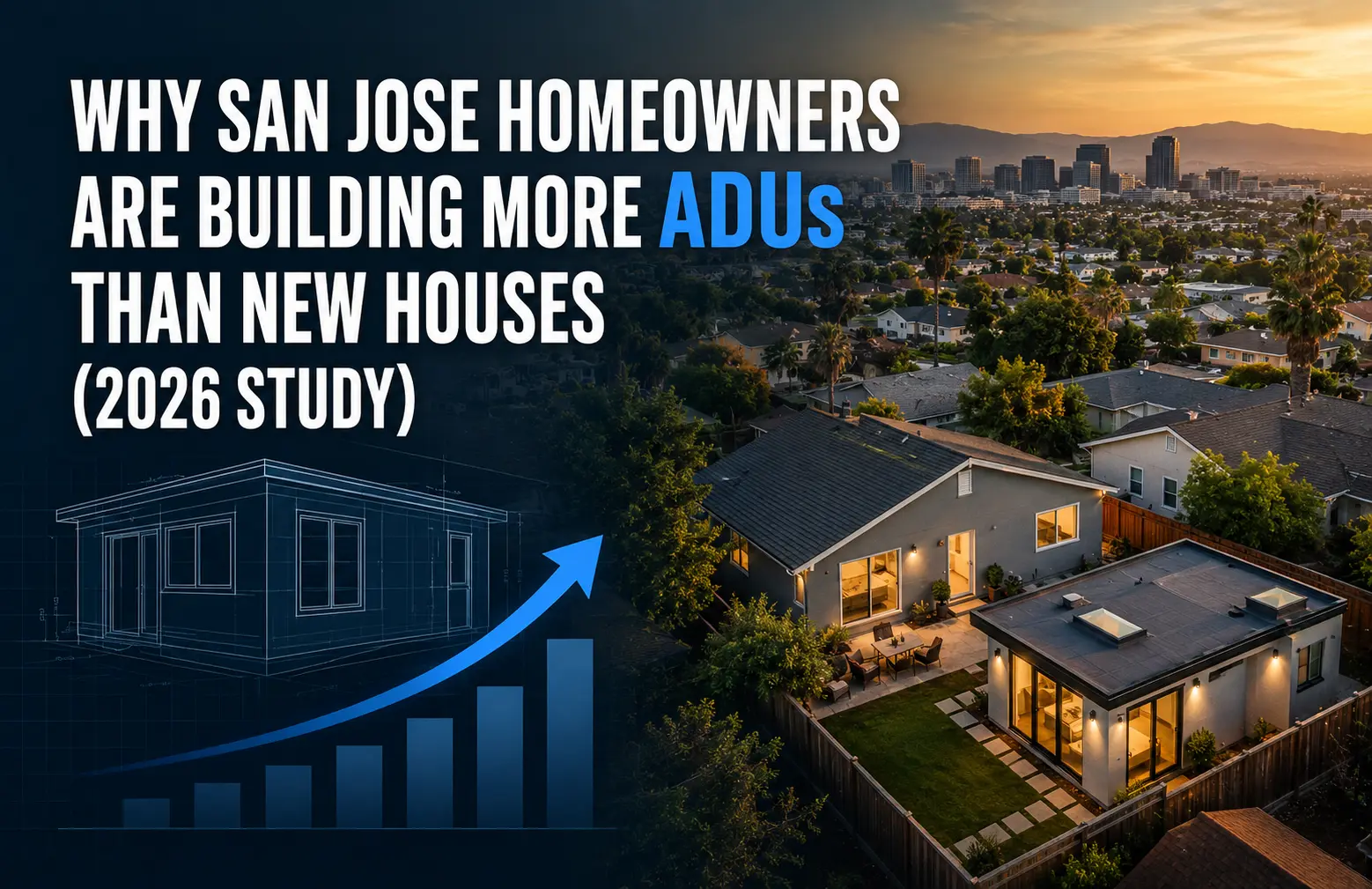
Given the growing popularity of accessory dwelling units (ADUs) in recent years, this article examines measurable evidence of a significant shift in residential development trends within San Jose. Using official permit data, it explores how ADU construction has increasingly outpaced new detached single-family housing and what this trend may mean for homeowners considering future development on their properties.
This includes comparing ADUs with home additions and full redevelopment of single-family homes in San Jose.
The article then provides context for understanding the role of ADUs within San Jose’s broader housing framework and the regulatory environment that supports them.
A Shift in Housing Paradigm
Why This Analysis Matters
Many San Jose homeowners face an important question when planning future development on their property:
Should I build an ADU or invest in a larger residential project?
To better understand how homeowners are answering this question in practice, this study examines official City of San Jose permit data over five years. The objective is to identify measurable housing trends and evaluate whether ADUs have become a leading development option compared with new detached single-family homes.
For many property owners, the decision is not simply whether to build an ADU. It is often a comparison between constructing an ADU, pursuing a home addition, or investing in a larger residential development project. Understanding how other homeowners have responded to recent ADU regulations may provide useful context when evaluating the most practical use of a residential property in San Jose.
Methodology
This analysis relies on official permit statistics published by the City of San Jose for ADUs and detached single-family houses. To evaluate mid-term development trends rather than short-term fluctuations, the data is divided into two separate three-year periods.
By comparing permit activity across these periods, the study provides a clearer understanding of how residential development patterns have evolved under California’s ADU incentive policies and local housing initiatives.
Permitted Single-Family Houses vs ADUs (Five-Year Study)
According to official City of San Jose housing statistics:
2017–2019
- Single-family houses: 1,033 permits
- ADUs: 698 permits
Ratio: 1.48 permits in favor of single-family houses
2023–2025
- Single-family houses: 168 permits
- ADUs: 1,085 permits
Ratio: 6.46 permits in favor of ADUs
These figures demonstrate a substantial change in residential development patterns. While new detached single-family homes were permitted more frequently during the earlier period, ADUs became the dominant form of permitted residential development during the later period.
Significant Change in Ratios
The comparison between these two periods reveals a notable transformation in San Jose’s housing trends.
Between 2017 and 2019, detached single-family homes were permitted at a higher rate than ADUs. By contrast, between 2023 and 2025, ADU permits exceeded detached single-family home permits by a ratio of 6.46 to 1.
The permit data indicates that ADUs have evolved from a secondary housing option into a major contributor to residential housing production. During the study period, substantially more housing units were created through ADU development than through the construction of new detached single-family homes.
Although permit data reflect construction activity, they do not fully capture homeowner intent, financing constraints, or redevelopment alternatives. However, the trend strongly suggests that ADUs have become one of the most commonly used development strategies for property owners in San Jose.
Incentive Policies and the ADU Housing Shift
In our article, “Comprehensive Full Rules and Updates,” we discussed the advantages that California ADU laws provide compared with traditional residential development.
Several factors may contribute to the increasing popularity of ADUs among homeowners:
- The ability to add housing on an existing residential lot.
- Opportunities for rental income and long-term property value enhancement.
- Housing flexibility for family members, caregivers, or multigenerational living arrangements.
- Streamlined state regulations intended to encourage ADU construction.
- Reduced zoning constraints compared with many forms of new residential development.
- More efficient use of land within established neighborhoods.
The permit trends observed in San Jose closely align with these policy objectives. As regulatory barriers have been reduced and development opportunities expanded, homeowners have increasingly utilized ADUs as a practical alternative to larger residential projects.
An Encouragement Study
This study is intended to guide San Jose homeowners who are evaluating development opportunities on their property.
The findings demonstrate that ADUs have become a significant component of the city’s housing production and are increasingly viewed as a viable solution for expanding living space, accommodating family members, generating rental income, or enhancing the property’s long-term utility.
While every property presents unique opportunities and limitations, the permit data shows that a growing number of homeowners are choosing ADUs as an efficient and flexible development strategy compared with constructing a new detached single-family home.
Understanding these trends can help property owners make more informed decisions before investing in design, permitting, and construction.
Related ADU Resources
Before moving forward, you may also find the following guides helpful:
- State of California ADU and JADU Guide
- Complete San Jose ADU Checklist
- San Jose ADU Zoning Ordinance Guide
- San Jose ADU Permit Process (FAQs)
Next Step
If you are considering building an ADU, home addition, or other residential project in San Jose, an early feasibility review can help identify development potential, zoning limitations, site constraints, and permit requirements before significant time and money are invested in design and construction documents.
Understanding what your property can realistically accommodate is often the first step toward a successful project.
References (Official Sources)
- Residential Construction – New Units by Type (City of San Jose Website)
- City of San Jose — PBCE Housing Production Dashboard
- City of San José Housing & Community Development Commission Regular Meeting Agenda, August 12, 2021
Online sources may be updated over time.
Disclaimer:
This content is for general informational purposes related to ADU design and planning and does not constitute legal, zoning, or permitting advice. Regulations vary by jurisdiction and may change over time. For project-specific guidance, consult your local planning department or a qualified professional. Requirements should be verified with the City of San Jose and may change over time.